


Operations Management Challenges in KSA | Overcome Them


Saudi organizations are finding that their needs for services are also becoming more demanding, with larger numbers of requests, access through a number of digital channels, and greater demands for visibility.
When teams rely on disjointed systems, onerous approvals, or minimal reporting, these pressures make operations management challenges difficult. There are tools that are connected that can connect workflows, data, and teams.
Operations Management Challenges in Saudi Arabi
Some of the typical issues in operations management challenges are slow approvals, duplicate data, unclear data ownership, lack of communication, and trouble keeping track of requests between departments. These issues can impact the efficiency of operations.
Consistent service can be difficult to provide to the organization for email, phone, portals, and messaging platforms. When each channel generates its own record, measuring response times, SLA compliance, and service quality becomes more difficult.
For organizations that want to move towards a digital transformation, these issues are closely connected to digital transformation challenges.
How Digital Transformation Addresses Operational Challenges
By connecting isolated tasks to processes, a practical digital transformation strategy helps minimize the challenges of operations management.
Automating repetitive workflows
Workflow Management can be automated using rules to reduce manual handoffs to minimize routing, approvals, escalations, and recurring tasks.
Connecting systems and departments
Connected systems minimize the information gaps between service teams, IT and administration, and other departments. A shared set of processes can be offered through an operations management software environment, rather than through separate tools.
Centralizing operational data
Having the records centralized facilitates the understanding of the activity. CDP can be managed in Secure Document Management, where information, permissions, and audit trails are organized.
Tracking requests from start to completion
A single request journey demonstrates who owns the request, its status, delays and next steps. This assists when requests are transferred between departments.
Using real-time dashboards and KPIs
Dashboards can monitor open requests, resolution times, SLA performance, service availability and customer feedback, providing managers with the real-time picture of the performance.
Improving digital service delivery
Omnichannel Customer Support can sync all channels, such as WhatsApp, email, portals, and phone, into a seamless service experience. Secure Electronic Signature can also streamline appropriate document approvals.
The goal is to be a connected operating model, not just another application.
How does AI improve operations management?
AI can mitigate the operations management challenges by categorizing and routing requests, summarizing information, drafting responses, and detecting patterns in operational efficiency data. The smart assistant, HAI, developed by Hollat, is able to assist in these service workflows while maintaining human review.
This is where the concept of AI CRM meaning and an AI CRM system comes into play. AI can link the context of a customer with service operations to better understand a request and provide more relevant information in response.
The monitor will identify a problem and issue a service ticket, and assets will link maintenance tasks to service requests, and the survey can gather input upon closure.
Hollat Success Stories in Saudi Arabia
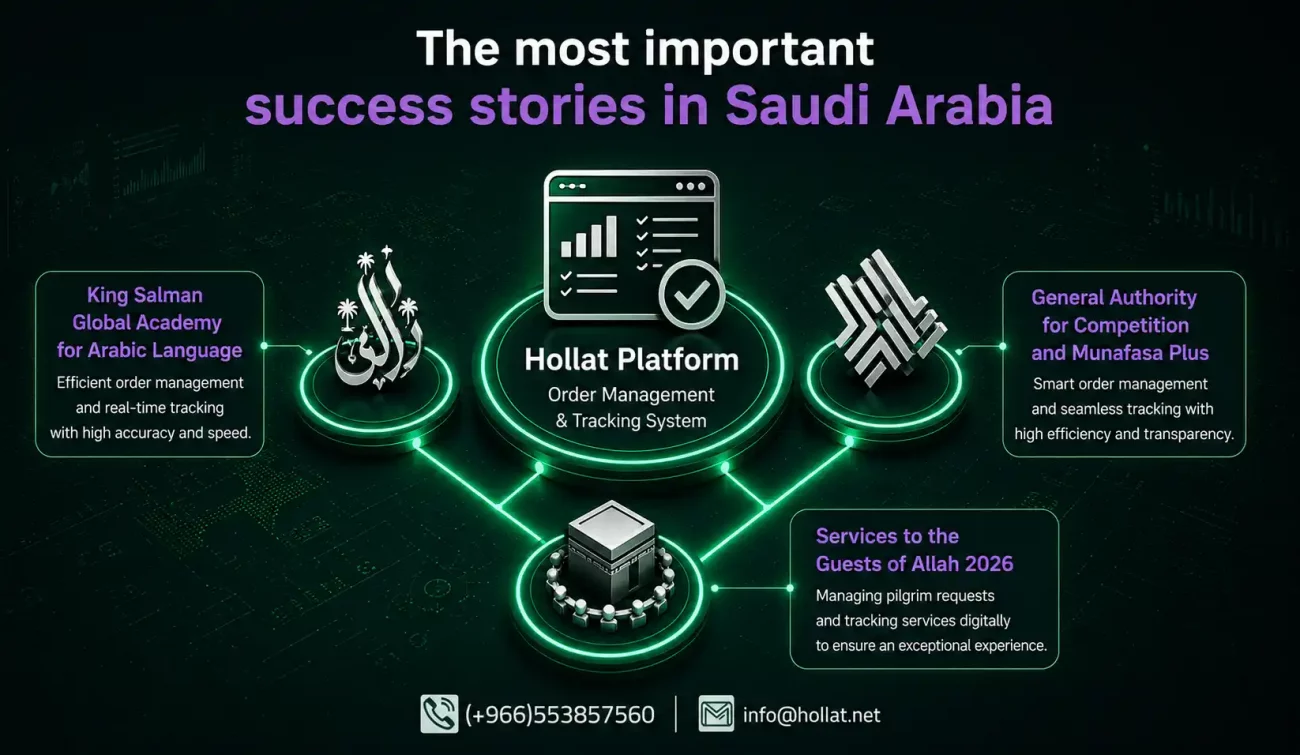
Hollat collaborates with Saudi government and institutional organizations with five related products: Platform, Masar, Monitor, Assets and Survey. Its success stories show the way organizations can organize requests, workflow, service performance, and operational visibility.
King Salman Global Academy for Arabic Language
Head of the General Authority for Competition and Munafasa Plus.Chairman of the General Authority for Competition and Munafasa Plus.
General Authority for Competition and Munafasa Plus
This success story highlights organized digital processes for managing requests and improving visibility from intake through completion.
Services to the guests of Allah 2026
Large seasonal services create operational pressure, making request routing, coordination, monitoring, and multichannel support especially important.
Khaled’s Approach to Operations Management Challenges
Khaled faced an operational challenge where requests and tasks involved multiple teams, making it difficult to maintain clear ownership, follow up on progress, and keep everyone working from the same information. These are common operations management challenges when service processes depend on disconnected tools and manual coordination.
Hollat addressed this through a connected service environment that brings requests, workflows, monitoring, assets, and feedback into one operational flow. Platform helps manage and route service requests, while Masar organizes related correspondence and approvals. Monitor provides visibility into service performance, and Assets connects maintenance activities with the relevant requests and assets. Survey can then collect feedback after service completion.
This approach gives Khaled a clearer view of each request from intake to completion, while helping different teams coordinate through shared workflows and operational data. It demonstrates how Hollat’s products can address operations management challenges across multiple functions rather than solving only one isolated task.
How Saudi Organizations Can Overcome Operations Management Challenges
Organizations can address operations management challenges through a structured approach:
- Map critical processes and identify repetitive manual steps.
- Define ownership, SLAs, escalation rules, and KPIs.
- Connect service, correspondence, asset, monitoring, and feedback processes where relevant.
- Centralize operational information and control access to sensitive records.
- Automate predictable work while retaining human review for important decisions.
- Use performance data to improve workflows continuously.
A connected ecosystem can bring IT service management ITSM, service requests, correspondence, assets, monitoring, and feedback into a more consistent operating model.
Hollat for Smarter Operations Management in Saudi Arabia
Hollat company offers a connected portfolio for organizations addressing operations management challenges. Platform manages services and requests with AI-supported routing and workflow automation. Masar handles correspondence, transactions, approvals, electronic signatures, and archiving. Monitor focuses on service availability, Assets manages asset lifecycles and maintenance, and Survey turns feedback into measurable insights.
Together, these products support clearer operational visibility. If your organization is facing operations management challenges, explore the products or request a demo to discuss the right combination for your workflows.
Ready to improve your operations? Contact our team and request a demo.
Frequently Asked Questions
What are the 5 current challenges of operations management?
There are five typical problems: disconnected systems, manual systems, limited visibility, unclear ownership, and inconsistent service delivery. Factors such as increased volume of requests, data silos, slow approvals, and challenging KPI measurement are other stress factors.
What are the major challenges faced by operations management?
The issues that arise are significant and include coordination of teams, cost control, service quality, workload management, performance tracking and change management. Clear processes, accountability, available data and periodic performance review are also crucial to improvement.
What are examples of operational challenges?
They can be things such as approval delays, duplicate records, undetected escalations, disconnected channels, asset downtime, slow resolution, and restricted reporting. Things get tricky when a service journey spans multiple departments, but there is no common workflow or data
What are the five management challenges?
There are five general challenges: planning resources, coordinating teams, controlling performance, adapting to change, and maintaining service quality. Data fragmentation, technology adoption, workflow complexity, and changing user expectations are also introduced to digital environments.