


Customer Service Platform for Better Customer Experience

As businesses have adopted digital transformation, and evolved their communication channels, so have customer expectations. In today’s digital age, customers demand a fast response, customization, and consistency in their engagements, no matter through email, WhatsApp, live chat, social media channels, or even self-service systems.
That will take more than a standard support desk, it will take a modern customer service platform that will meet those expectations. A cloud-based customer service platform provides the customer service team complete visibility of the customer’s requests, and automates repetitive tasks. Agents won’t need to toggle between systems to handle conversations, track service levels and troubleshoot problems, all from a single interface.
What Is a Customer Service Platform?
A customer service platform is a Unified software tool that enables organizations to handle questions, service requests, complaints, and best customer support system operations in the same central place from different communication means.
Customer service platforms are distinct from standalone support applications, and a great platform seamlessly integrates the many aspects of customer interaction and internal operations and seamlessly integrates them into a single place: performance reporting. This helps support teams work more effectively together and makes sure that customers get timely, consistent support.
Most modern customer service platforms fit a range of businesses, including:
- Government entities.
- Large enterprises.
- Healthcare organizations.
- Financial institutions.
- Educational institutions.
- Service providers.
Core features of a Modern Customer Service Platform
An efficient customer service platform integrates various key features, which process consumer help such as deal with suppliers and boosts the general customer experience.
Ticketing and Request Management
All contacts with customers must be tracked from the moment they come in until resolved. Ticketing systems automatically structure requests, enable agents to prioritize requests, pass ownership, and track the progress of requests throughout the lifecycle of support.
Benefits include:
- Centralized request tracking.
- Faster issue resolution.
- Better workload distribution.
- Complete service history.
- Improved accountability.
Help Desk and SLA Automation
Successful help desk centers do so much more than take notes on customer requests. SLA (Service Level Agreement) management enables organizations to set response and resolution goals, and also lets them automatically track against these goals.
Automation helps by:
- Assigning tickets to the appropriate teams.
- Escalating overdue requests.
- Sending automatic notifications.
- Tracking SLA compliance.
- Minimising paper administration processes.
Workflow and Process Automation
Workflow automation enables businesses to streamline their work process optimizations, eliminate repetitive tasks, and standardize their internal processes, all while cutting down on delays that occur due to manual approvals.
Examples include:
- Automatic ticket routing.
- Approval workflows.
- Service request escalation.
- Notification management.
- Process monitoring.
Multi-Channel Communication
Depending on the customer’s preferences, he communicates with the buyer through various channels. All of these conversations can be viewed via a modern customer service platform within one space.
Suited modes of communication can involve:
- Email.
- WhatsApp.
- Live Chat.
- Social Media.
- Customer Portals.
- Mobile applications.
Core Features Overview
| Feature | Business Value |
| Ticket Management | Organizes customer requests efficiently |
| SLA Automation | Improves response and resolution performance |
| Workflow Automation | Reduces repetitive manual work |
| Omnichannel Communication | Creates a unified customer experience |
| Reporting & Analytics | Supports data-driven decisions |
| Knowledge Base | Enables faster problem resolution |
How a Customer Service Platform Improves Customer Experience
speed, consistency, and the quality of the communication are key to customer experience. By providing your agents with full visibility into customer interactions, a modern customer service automation platform can make it easy for your organisation to deliver all three.
The best things are:
- Faster first-response times.
- Better issue tracking customer service automation
. - Personalized customer interactions.
- Uniformity in communication through channels.
- Blueprints can be created and resolved more quickly.Ticket response times are decreased.
- Improved service transparency.
Organizations can also obtain valuable performance information from which they can determine recurring issues and continually enhance processes of support.
Customer service software is part of a larger digital transformation platform that empowers companies to modernize their actions in a manner that increases their effectiveness at engaging with customers.
Hollat Complete Customer Service Platform Trusted by Saudi Institutions
Essential customer service is more than a support resource, and it’s the enterprise automation platform for great customer experiences in today’s modern world. When an organization can handle intelligent tickets management, communication via multiple channels, workflow automation, monitoring and adherence to SLA, artificial intelligence features, and detailed reporting, it will be able to respond quicker, function more efficiently, and foster better customer relationships.
From just beginning the digital transformation journey to expand and improve an existing support operation, Hollat has a scalable solution to match the changing business’s needs. Whether you’re a government agency or an enterprise organization, Hollat can help your team to optimize working methods and operations, boost productivity and provide customers with a cohesive service programme at each interaction. To see how a single customer service solution can improve your Customer Service strategy, and contribute to your success over time, reach out to the Hollat team today.
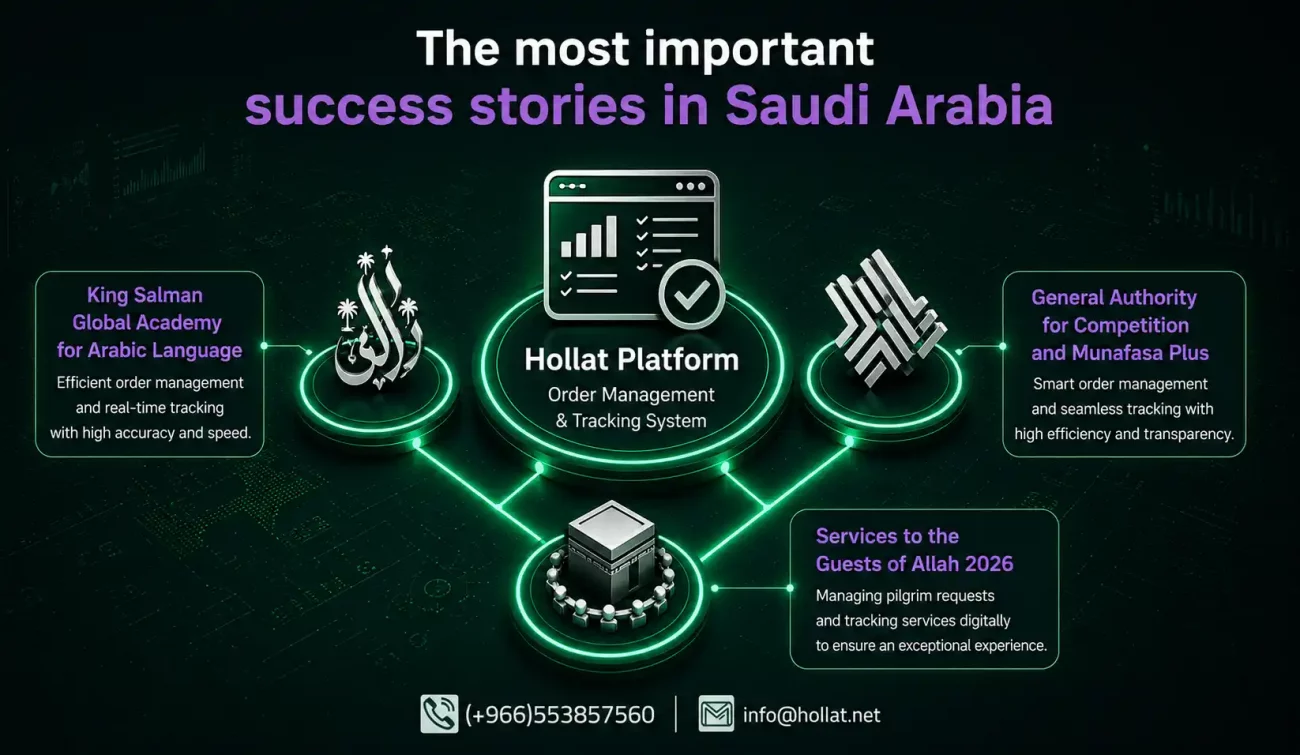
King Salman Global Academy for Arabic Language
Hollat was chosen to provide the King Salman Global Academy for Arabic Language with a new contact center environment to support their customer communications. The Academy’s focus on managing interactions at a reduced level and making service visible will provide a more consistent support experience which will be responsive, reducing the burden on the customer and providing a better experience of the service for its clients.
General Authority for Competition and Munafasa Plus
The General Authority for Competition (GAC) has selected Munafasa Plus (powered by Hollat) to bolster digital communication with users and service delivery. The platform allows companies to streamline their customer requests handling while also allowing for smooth communication on various channels.
services to the guests of Allah 2026
The platform also features enhanced services for the business side of Services to the Guests of Allah 2026 initiatives, proving its capacity to ensure performance for large-scale public sector projects, when dealing with many people, and with many conversations. Request management and multi-channel support are provided in a centralized manner, ensuring quality of service even during peak times.
These implementations show the use of customer service technology that the Saudi institutions are using to enhance their operational performances and the satisfaction of customers.
Benefits of a Unified Customer Service Platform for Businesses
The situation of having several isolated tools can lead to inefficiencies, redundant work, and sub-optimal customer experiences. These problems can all be solved with a single customer service solution that consolidates support activities in one place.
They feature all these key business benefits:
- Quick and efficient response & resolution.
- Enhanced interdepartmental working.
- Improved visibility into customers’ interactions.
- Centralized information reporting and analytics.
- Reduced operational costs.
- Process automation to boost productivity.
- Consistent experiences with the customer no matter the medium.
- Reliable cloud systems with scalable infrastructure, which can expand easily to meet business requirements.
How to Choose the Right Customer Service Platform
You need to consider both priorities of operational requirements and future business growth when choosing the appropriate customer service platform.
- Based on the following, make a choice:
- Ability to connect with several communication paths.
- In-built ticket management and support function.
- Workflow and business process automations.
- SLA monitoring and reporting features.
- AI-powered productivity features.
- Cloud-based deployment for easy scalability.
- Secure access and security measures.
- Interoperability with other business applications.
- Easy-to-use interface for both agents and administrators.
- Expertise in helping enterprise and government organizations.
Join Hollat on a journey to enhance Customer Experience to help you achieve your aims more efficiently.
Deliver Better Customer Experiences with Hollat
Essential customer service is more than a support resource, and it’s the platform for great customer experiences in today’s modern world. When an organization can handle intelligent tickets management, communication via multiple channels, workflow automation, monitoring and adherence to SLA, artificial intelligence features, and detailed reporting, it will be able to respond quicker, function more efficiently, and foster better customer relationships.
Contact the Hollat team today to discover how a unified customer service platform can transform your customer support strategy and drive long-term operational success
Frequently Asked Questions
What’s the difference between a customer service platform and a CRM?
Customer relationship management mainly focuses on managing the relationship with customers and sales and marketing information. A customer service platform has a main purpose of managing customer support requests, ticket processes, service workflows, and communication on various channels. A number of organizations are combining both systems for delivering a flawless customer experience.
Do I need separate tools for help desk, CRM, and automation, or one unified platform?
A single solution can streamline processes by bringing together customer interactions, workflow automation, reporting and support management. This will simplify complexity, facilitate teamwork, and lessen the number of different systems used.
What are the most popular customer service platforms?
Reporting features, ability to integrate with other systems, omnichannel communication, automation capabilities, and scalability are several factors that many platforms consider when evaluating. Popularity alone is the least important factor when choosing the best option; business requirements, security needs, and operational goals are more important.
What are the 4 types of customers in customer service?
There are many customer service job classifications, but the ones that are more commonly found are:
- New customers.
- Returning customers.
- Loyal customers.
- High-support or complex customers.