


Best SaaS Automation Platforms for Smart Business Growth


SaaS Automation Platforms has evolved from a mere luxury to a strategic necessity as organizations continue to adopt a digital transformation strategy. Automation of repetitive tasks, service requests, and approval processes in governmental bodies and projects/services completed by private companies lets its teams run more efficiently and improve service quality. Today, a modern organization has no need to work with one-off systems and paper-based work. Rather, they embrace the concept of a smart automation solution that unifies processes, minimizes human intervention, and offers greater transparency of what is happening each day. Platforms such as Hollat can be a valuable tool for organizations looking to streamline their business workflows while still offering flexibility, safety, and scalability.
What is the meaning of SaaS automation?
SaaS Automation Platforms is the process of enabling cloud-based software to automate business workflows, repeating tasks, business approvals, and services management without complicated on-premise systems and infrastructure.
Rather than being dependent on spreadsheets, email, or manual approvals, organizations utilize a central automation platform by linking departments and workflows.
When it comes to automated processes, here are some of the more common ones:
- Employee onboarding
- Service request automation
- Approval workflows
- IT service management
- Customer support
- Financial process automation
- Asset management
- Internal communication
SaaS solutions run in the cloud, enabling organizations to launch new workflows more efficiently, easily scale operations, and access services securely from anywhere.
Why Does SaaS Automation Matter for Business Growth?
African American-owned retail stores can only upkeep growth if they are effective, responsive, and provide great services. Manual activities often cause delays with operations, bottlenecks, and risks associated with operations.
A modern SaaS automation solution can solve these problems by streamlining workflows and facilitating communication and collaboration between teams.
Many of the most significant benefits are the following:
Improved Productivity
Staff members are relieved from repetitive administration and more dedicated to tackling business strategic challenges.
Faster Decision-Making
Automated workflows cut down on delays by sending the right folks the right apps right away!
Better Customer Experience
Organizations can handle requests more efficiently, improve response time and maintain consistent and accurate communication with customers with customer service automation.
Enhanced Operational Visibility
Managers get real-time access to analytics and dashboards that track workflow performance, service levels and efficiencies.
Easier Scalability
With expansions, SaaS platforms enable companies to extend their workflows without leaving the dollar part.
Business Impact of SaaS Automation
| Business Area | Manual Process | SaaS Automation |
| Service Requests | Email-based tracking | Automated request routing |
| Approvals | Paper forms | Digital approval workflows |
| Customer Support | Manual follow-up | Intelligent customer service automation |
| Financial Operations | Multiple disconnected systems | Streamlined Financial Services Automation |
| Reporting | Manual data collection | Real-time dashboards |
This transition enables organizations to be more dynamic, and more efficient to run across departments.
SaaS automation vs. traditional manual workflows
However, while work is still being performed with manual processes in many organizations, digital transformation has made the need for more efficient processes become apparent.
The following is a comparison of both methods.
Traditional Manual Workflows
Manual operations have the following characteristics:
- Paper documentation
- Email approvals
- Multiple spreadsheets
- Repetitive data entry
- Limited visibility
- Higher error rates
These approaches may have a dramatic impact on the performance of the organization particularly as a business grows.
SaaS Automation Workflows
Today’s SaaS developments address broken processes by introducing smart task workflows that take care of repetitive tasks automatically.
Key advantages include the following:
- Centralized service management
- Automated notifications
- Workflow tracking
- Real-time reporting
- Digital approvals
- Integration from Business Functions.
- Faster service delivery
Organizations receive thousands of service requests per month, and the response times for service requests can be significantly reduced with service request automation, and reliability and accountability are enhanced.
Key Features to Look for in a SaaS Automation Platform
The process of research and selection of the SaaS Automation Platforms are not as straightforward as it sounds because of more than just digitizing workflows. The best answers will include the ability to grow with the company for the long term, evolve with the organization’s evolving requirements, and enable easy integration for the people working with it and for it.
When assessing an automation platform, take into account these characteristics:
Workflow Automation
The platform should enable organizations to automate repetitive processes in business without much coding to be done, which includes task assignments, notifications and approvals.
This helps to remove repetitive work further to guarantee that all procedures comply with pre-defined business rules.
Service Request Automation
A successful platform should make it easy to submit, assign, track and resolve service requests.
Employees and customers can make requests via a single portal, which enhances transparency and response times, rather than email or a paper-based system.
Customer Service Automation
The crucial factor for providing excellent customer support is speed and consistency.
With customer service automation, companies can:
- Automatically route customer inquiries.
- Prioritize urgent requests.
- Monitor response times.
- Improve service-level performance.
- Keep full record of all communications.
Such power features help to boost customer satisfaction and lighten support personnel load.
AI-Powered Capabilities
Artificial intelligence has become a growing part of modern automation systems, helping to enhance efficiency.
AI can help organizations in the following ways:
- Categorizing service requests.
- Suggesting knowledge articles.
- Automating repetitive responses.
- Identifying workflow bottlenecks.
- Going through intelligent suggestions for faster resolutions.
These capabilities enable a team to function smarter and not harder.
Real Success Stories Hollat Across Saudi Institutions
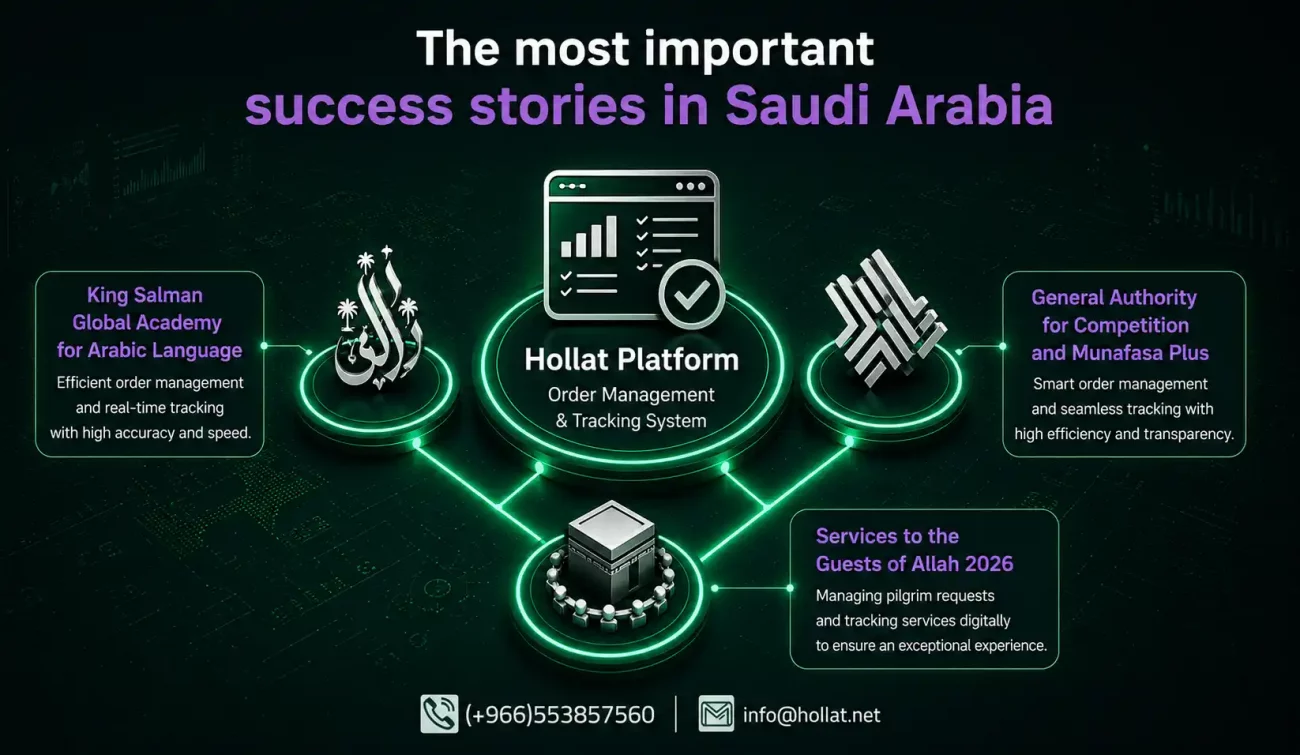
The more successful an automation platform can be in real implementations, the more it is effective.
Hollat has helped several entities in Saudi Arabia to digitize their services, minimize decelerating operations, and optimize user experience.
King Salman Global Academy for Arabic Language
The King Salman Global Academy for Arabic Language aims to help advance the Arabic language from the fields of education, research and development, and digital media while safeguarding it.
To support such an institution, it is necessary to have efficient internal processes and digitized services.
Implementing workflow automation can save the academy from approving things repeatedly, facilitate smoother interdepartmental collaboration, and make the work of employees and stakeholders better.
General Authority for Competition and Munafasa Plus
Munafasa Plus was launched by the General Authority for Competition to enhance the digital services and make interactions with beneficiaries easier.
As the number of digital requests increases, it is essential to have a workflow and deliver sustainable services.
Automation provides companies the ability to
- Reduce processing times.
- Improve transparency.
- Improve request tracking. Accurately log requests.
- Enhance communication with users.
- Increase operational efficiency.
These enhancements will help deliver higher-quality public services but reduce administrative burden.
services to the guests of Allah 2026
Saudi Arabia is still spending vast resources on digital transformation projects that aim to improve services that are offered to pilgrims and visitors.
A major challenge in the organization of national programs is to coordinate with multiple organizations in an efficient fashion, which necessitates automation for effective service provision.
These initiatives are supported by workflow automation, which can help with the following:
- Faster approvals.
- Better collaboration.
- Centralized service management.
- Improved response times.
- Unified user experiences.
Digital platforms can also give improved visibility of operational performance as the services are monitored and outcomes continually improved during peak demand periods.
The examples show the possibilities of institutional autocontour levels and national levels.
Why Hollat Is a Strong SaaS Automation Choice for Government and Enterprise

This choice of a SaaS automation platform may affect an organization’s competitiveness, service delivery, and digital transformation efforts. What these government agencies and organizations are in need of is a solution that can streamline processes and accommodate changing business needs.
Hollat provides a single service suite for companies that will reduce the complexity for dealing with services, streamline the workflow, and benefit from better collaboration between departments. Once in a single place, teams will be able to produce requests, approvals, customer communications, and procedures instead of relying on standalone systems.
Allied with achieving the goals to incorporate the following considerations into business communications:
- Flexible workflow automation that meets a variety of business processes.
- Automated services, improved efficiency, centralized.
- Fully featured customer service automation that allows businesses to be more responsive to customers.
- Advanced tools integrated with AI, designed to aid smarter decision making and productivity.
- Dashboards and analytics with real-time operational data.
- Encryption for enterprise and government uses.
- Elastic permissioning that enables organization expansion and future digital initiatives.
Whether the goal is improving financial services automation, simplifying payment process automation, or enhancing customer engagement, adopting a scalable SaaS automation solution provides a strong foundation for sustainable growth.
Frequently Asked Questions
Is ServiceNow worth it for a mid-sized organization, or are there better alternatives?
As a good enterprise-class platform, ServiceNow can be in excess of what some mid-level companies will need. The ease of implementation, the required customization, and the applicability to scale-up and TCO are standard business criteria used to assess alternatives. Solutions like Hollat can be an attractive option for organizations looking for a flexible platform tailored to their operational requirements.
Can SaaS automation platforms support Arabic and RTL interfaces?
Yes. Right-to-left (RTL) interfaces and multiple languages, such as Arabic, supported by many modern SaaS automation platforms. Especially for companies that function in the Arabic speaking markets, such as Saudi Arabia, this can boost user experience for employees and customers.
How long does it typically take to implement a SaaS automation platform?
The implementation time can differ based on the size of the organization, the number of workflows, the integrations that are needed, and the degree of customization. Typically it takes a few weeks to complete smaller projects and a few months for larger enterprise deployments. Well-organized and appropriate consultation with interested parties facilitates implementation and enhances project success.